Rent a Boat in Santorini or 5 Other Ways to Explore the Cyclades
Santorini is one of the most recognisable silhouettes in the Mediterranean – the flooded caldera, the white-cube villages on the rim, the abrupt drop from the clifftop to the sea below. Most visitors experience it from a hotel terrace or a crowded viewpoint. The perspective changes completely when you approach from the water, moving through the caldera mouth at your own pace and anchoring in places that the tour boats never reach.

The six sections below outline the range of what the island and its surrounding Cyclades offer in summer: sailing as the most immersive option, followed by five activities that fill out a longer stay on land.
1. Rent a Boat in Santorini and Sail the Southern Cyclades

a view looking back at Fira, Santorini from sea
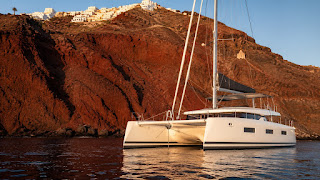
The Vlichada Marina, on the south coast of Santorini, is the main departure point for bareboat charters in the area. The marina sits below the island’s famous pumice cliffs – layered red, black, and grey volcanic tuff and is far quieter than the tourist crowds above in Oia or Fira and enable the best views of Santorini. Most boats available here are monohulls and catamarans in the 36–50 foot range, suitable for the open water passages between the Cycladic islands.
The sailing conditions in this part of the Aegean are shaped by the meltemi, a northerly wind that builds through July and August and can reach force 5–6 on exposed passages between islands. For crews with offshore experience the meltemi is a pleasure – fast downwind runs, short passages, and anchorages in sheltered coves behind each island’s southern flank. For those with less sea time, May, June, and September offer the same islands with lighter and more variable winds.
A standard week-long circuit from Vlichada might take in the volcanic islets of Nea Kameni and Palea Kameni inside the caldera, then south to Ios, across to Sikinos and Folegandros – two islands that remain genuinely quiet despite their proximity to Santorini – and back via the western coast. Longer passages east to Amorgos or north to Naxos and Paros are possible for crews with two weeks and a preference for variety.
If you want a boat hire in Santorini you will find compare available models for your dates. there are many options.
2. Eat Around the Caldera: Santorini’s Local Food Culture

Santorini’s volcanic soil is shallow, dry, and mineral-rich – not ideal for most crops, but extraordinary for a handful of varieties that have adapted to it over centuries. The island’s cuisine is built around these.
Fava, made from the yellow split pea grown on Santorini rather than standard broad beans, is the most distinctive local product. The soil gives it a sweetness and density that generic Greek fava doesn’t replicate. It is served cold with capers, raw onion, and olive oil at virtually every serious taverna on the island. Order it once at a tourist terrace restaurant, then order it again at a village taverna inland and notice the difference.
Santorinian tomatoes – small, dense, low-moisture, intensely sweet – grow in baskets on the volcanic pumice and need no irrigation. The tomato products to look for are fresh in season (July through early September), as well as the sun-dried version and tomatokeftedes, the fried tomato fritters that appear on nearly every mezze plate.
The white wines from Assyrtiko grapes: dry, crisp, high in acidity, with a marine mineral character – are the correct accompaniment. Wineries such as Santo Wines, Gaia, and Estate Argyros all have tasting rooms on or near the caldera rim.
3. Hiking the Caldera Rim from Fira to Oia

Donkeys making the climb in Fira, Santorini
The most underrated way to see the caldera is on foot. The Fira to Oia trail runs approximately 10 kilometres along the rim, with the caldera dropping away to your left the entire way. It passes through the villages of Firostefani and Imerovigli before descending into Oia at the northern tip of the island.
The trail is well-worn but not always well-marked – a simple offline map downloaded before you set out saves confusion at the two or three junctions where the path splits. Underfoot it varies from smooth paved sections through the villages to loose volcanic gravel on the open ridgeline sections in between.
Timing matters considerably here. The walk in July or August in full midday sun is uncomfortable and potentially dangerous for those not acclimatised to the heat. Starting from Fira at sunrise – roughly 6:00–6:30 in midsummer – means arriving in Oia by late morning with the light behind you and the worst of the heat still ahead of the afternoon. The return is by local bus or taxi rather than the same trail back.
4. Archaeology at Akrotiri and the Ancient Thira Site
Two significant archaeological sites sit on opposite ends of the island and together span nearly 3,500 years of human settlement.
Akrotiri is the more dramatic of the two. A Minoan-era city buried by the volcanic eruption of around 1600 BCE – the same eruption that collapsed the caldera and possibly inspired the Atlantis myth – was excavated from the early 1970s and is now partially protected under a large roof structure. The preservation is exceptional: frescoes, storage vessels, two-storey buildings with intact stairwells, and a sophisticated drainage system remain largely in place. The site opens at sunrise and is worth arriving early before tour groups arrive from cruise ships around 9:00.
Ancient Thira sits at 369 metres on the Mesa Vouno ridge, accessible by a steep road from either Kamari on the east coast or Perissa on the south. The city dates from the ninth century BCE and was inhabited through the Byzantine period. The panoramic position – sea on both sides, islands stretching to the horizon – explains why the site was chosen and makes the climb worthwhile even for visitors with limited interest in archaeology.
5. Beach Days: Black Sand, Red Cliffs, and the Eastern Bays

Santorini’s beaches are unlike any others in Greece, shaped entirely by the island’s volcanic character.
Perissa and Perivolos, on the south coast, share a long stretch of black volcanic sand – visually striking, though the dark material absorbs heat and becomes genuinely hot by midday. Both beaches are well-organised with sunbeds, beach bars, and shallow entry suitable for families. Perivolos is slightly further from the main ferry traffic and consequently quieter.
Red Beach, west of Akrotiri, sits below a wall of deep-red volcanic cliffs. It is one of the most photographed natural features in the Cyclades and predictably crowded in season. The approach involves a short scramble over rocks from the car park; the swim is good but the space fills up by 10:00 in July and August. An early arrival or a late-afternoon visit avoids the worst of the crowds.
For those spending time on the water, several small coves on the caldera’s inner wall – particularly around Ammoudi Bay below Oia – are accessible only by sea. Anchoring here for a swim stop in the late afternoon, when the caldera rim is lit in the angled summer light, is among the better reasons to have a boat.
6. Sunset, Nightlife, and the Villages After Dark
Santorini’s sunset is one of the most-discussed sunsets in the world, which creates a predictable problem: the Oia viewpoint at 20:30 in August is standing-room only, and most of the experience is documenting the crowd rather than watching the light. There are better approaches.

the crowds gather for the sunset
Imerovigli, a smaller village on the rim between Fira and Oia, has the same westward exposure and a fraction of the crowds. The sunset from the Skaros Rock trail above Imerovigli – a 20-minute walk from the village – gives the full panorama without the shoulder-to-shoulder situation.
From the water, the sunset over the caldera rim viewed from a boat anchored inside the caldera is the undisputed best position. The light changes from gold to deep orange across the entire cliff face simultaneously.

taking the sunset selfie in Fira, Santorini
After dark, Fira operates as the main nightlife centre, with cocktail bars and clubs concentrated along the pedestrian strip near the cable car station. The energy is consistent from July through early September. Oia quiets down significantly after the sunset crowd disperses, which suits those who prefer a slower evening.
Planning Notes
The high season on Santorini runs from late June through early September. July and August bring peak prices, maximum crowds, and the strongest meltemi winds. May, June, and September are the better months to experience the true splendor of Santorini and having a balanced trip: warm sea temperatures, manageable numbers of visitors, and – for those sailing – more predictable and lighter conditions for planning multi-day passages through the southern Cyclades.
The island’s position at the southern edge of the Cyclades makes it a natural endpoint for a one-way charter rather than a loop base. Some crews choose to start further north – in Paros or Naxos – and work their way down to Santorini for the final night, leaving from Vlichada after a week of island-hopping.